- The Dawn of a New Era: Beyond the 1.5 Million Threshold
- The Three-Layer Network: Curing the Fragmented Terminal
- Kobe Sannomiya Hankyu Building: The Vanguard of the 2020s
- JR Sannomiya New Station Building: The Long-Awaited Anchor
- Sannomiya Twin Gate: A Global Transit Hub
- City Hall Building No. 2: The Arrival of Conrad
- The Masterstroke: The Strategic Ban on Tower Mansions
- Conclusion: Growth Requires Patience
The Dawn of a New Era: Beyond the 1.5 Million Threshold
For a long period following the 1995 Great Hanshin Earthquake, Kobe was a city defined by its “recovery mode.” Unlike other major Japanese metropolises that could afford flamboyant urban expansion, Kobe was forced to prioritise the repayment of immense municipal debt. This era of fiscal discipline, while necessary, meant that large-scale redevelopment remained on the horizon for decades. Now, with the debt finally brought under control, the city has unleashed a “once-in-a-century” redevelopment plan at city centre. This strategy shifts the focus from the post-quake recovery of the south-western areas toward a high-intensity evolution of the central Sannomiya terminal.
To be honest, I have always felt that for a metropolis of 1.5 million people, Sannomiya’s station front lacked a certain “metropolitan dignity.” It felt stagnant, caught in a time capsule while our neighbours in Osaka and Kyoto raced ahead. Therefore, seeing the news of these massive projects finally breaking ground was more than just exciting—it was a profound relief. We are finally witnessing the physical manifestation of Kobe’s pent-up potential. While the north side of the station retains its gritty, organic charm, the south side is being polished into a sophisticated gateway. The contrast between these two faces of the city will only grow more pronounced, highlighting Kobe’s unique ability to balance tradition with cutting-edge urbanity.
The Three-Layer Network: Curing the Fragmented Terminal
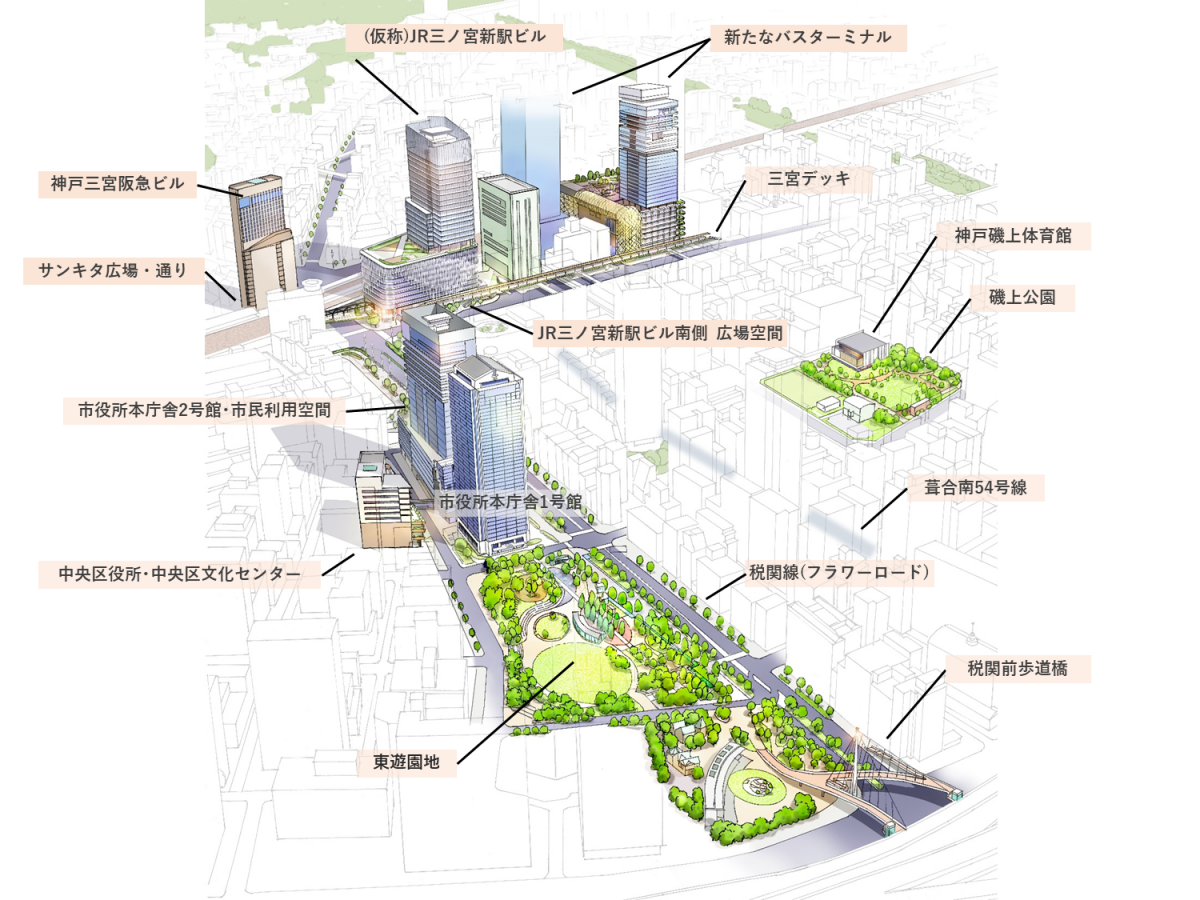
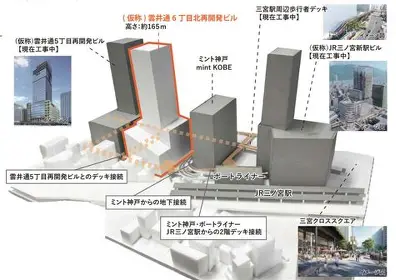
The “Sannomiya Cross Square” initiative is the structural backbone of this transformation. It aims to unify six disparate railway stations into a seamless “Eki-Machi” (Station-Town) space through a “Three-Layer Network.” This vision integrates the underground (the recently renovated Santica and subway nodes), the ground level (pedestrian-first plazas), and an expansive elevated deck system. Crucially, the city has approached this with data-driven precision, improving the distant Kasugano intersection to manage traffic volume before reducing vehicle lanes in the city centre.

This is the point I want readers to truly understand: this isn’t just about building pretty towers. It is about fixing a fundamental urban flow that has been broken for years. Having spent a significant amount of time navigating the slightly inconvenient, fragmented underground paths of the old Sannomiya, seeing the newly polished subway nodes gives me great hope. While the current construction makes the station area a maze of detours, I find myself looking forward to the result with anticipation rather than frustration. The fact that the administration took the time to report on traffic volume and improve peripheral intersections before breaking ground shows a level of discipline that makes me confident this isn’t a “shot in the dark,” but a calculated surgical fix.
Kobe Sannomiya Hankyu Building: The Vanguard of the 2020s
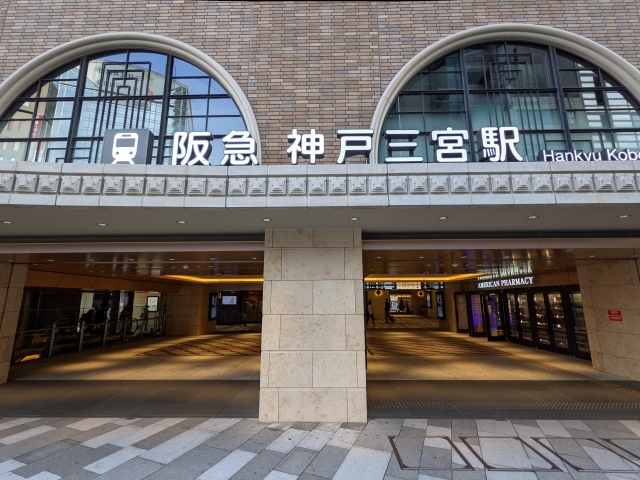
Opening in 2021, the Kobe Sannomiya Hankyu Building served as the opening fanfare for this decade of growth. The skyscraper features the high-end “Remm Plus” hotel and sophisticated retail spaces, but its true value lies in its architectural dialogue with the past. The lower facade is a meticulous homage to the original pre-war Hankyu building, lost in the 1995 earthquake, featuring the iconic large arches that once defined the city’s skyline.
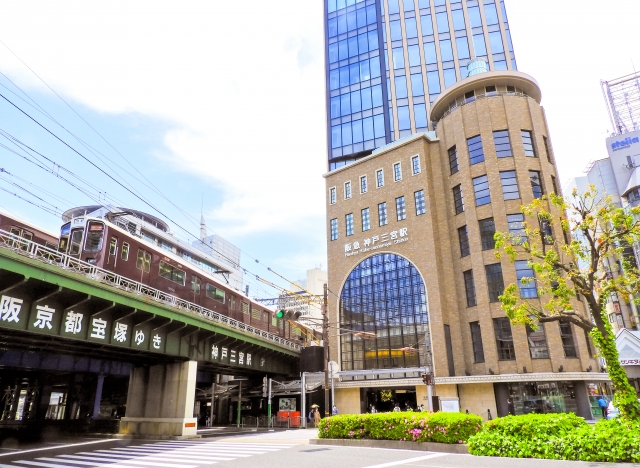
This project set a brilliant precedent for what followed. By blending a stylish, modern tower with an aesthetic tribute to our history, it proved that Sannomiya’s value could be elevated without sacrificing its soul. Every time I see those arches, I am reminded that Kobe’s redevelopment is about more than just “newness”—it is about restoration and pride. It showed that we could be stylish, functional, and historically respectful all at once, raising the bar for every project that has since broken ground.
JR Sannomiya New Station Building: The Long-Awaited Anchor
The definitive “main event” of this era is the JR Sannomiya New Station Building. While JR stations in other cities evolved years ago, Sannomiya’s transformation was deliberately paced to align with the city’s broader pedestrianisation goals. Currently under massive construction, the 155-metre tower will house premium commercial spaces, offices, and a luxury hotel. It is designed to be the physical hub of the aerial “Human Deck,” connecting the railway directly to the surrounding city.

This is the piece of the puzzle we have been waiting for. It is true that the project took time to commence, but in my view, this delay was strategic rather than stagnant. The new building will act as the commercial and functional heart of the entire district. Even though the steel frames are only just beginning to climb, the sheer scale of the activity in front of the station is a landmark in itself. It has been years of looking at construction fences, but once this anchor is dropped, the “face” of Kobe will be unrecognisable in the best way possible.
Sannomiya Twin Gate: A Global Transit Hub
To the east of the central hub lies the Kumoidori redevelopment, known as the “Sannomiya Twin Gate.” Phase 1 (5-Chome) is already seeing its steel frame rise rapidly, and Phase 2 (6-Chome-north) is set to follow. The lower levels of these towers will serve as a massive, integrated bus terminal, consolidating the city’s medium- and long-distance transport. This project is vital for its potential to capture demand from even the Chugoku and Shikoku regions and create synergy with the internationalisation of Kobe Airport.
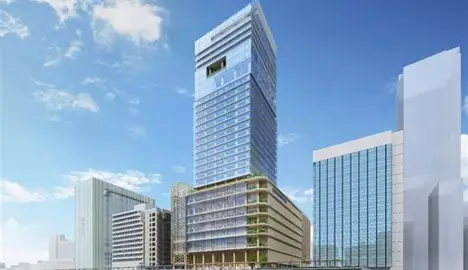
The “Twin Gate” is Kobe’s handshake with the rest of the world. By creating a high-end transit hub that handles regional bus traffic with the same grace as an international terminal, we are expanding Kobe’s reach far beyond its municipal borders. I have been watching the steel grow from a distance, and the speed of progress is staggering. Though I have not been able to conduct an on-site report recently, the visual evidence of its growth signals a new era for Kobe as an international player. I look forward to providing more updates as these towers continue to reach toward the sky.
City Hall Building No. 2: The Arrival of Conrad
The reconstruction of City Hall Building No. 2 has evolved from a utilitarian civic project into a symbol of global ambition. Originally planned for a 120-metre height, the project was expanded to 140 metres—surpassing Building No. 1—to accommodate the world-renowned Conrad Hotel on its upper storeys. This fusion of administrative function and world-class luxury hospitality is designed to elevate Kobe’s international prestige and draw in high-level global business.
I am particularly captivated by the “Twin Tower” silhouette this will create with Building No. 1. There were those who questioned whether 120 metres was sufficient, but the decision to go further and secure a brand like Conrad was a masterstroke. It signals that Kobe is no longer just a “local” administrative centre, but a city ready to host the global elite. Seeing the stylish renders makes me realise how far we have come from the utilitarian mindset of the past.
The Masterstroke: The Strategic Ban on Tower Mansions
Perhaps the most distinctive element of Kobe’s strategy is the 2020 policy banning new tower mansions in the area from Shin-Kobe to Sannomiya and Kobe Station. Furthermore, residential construction is strictly prohibited in the immediate vicinity of Sannomiya Station. Every major development in the core is dedicated to “urban functions”—commercial, office, and hotel spaces. This ensures that the city centre remains an active economic engine rather than a quiet residential dormitory.
This policy is, in my eyes, the “True Goal” of the city’s leadership. While many cities chase quick tax revenue by allowing developers to fill their station fronts with luxury condos, that is a short-sighted trap that leads to declining urban vitality in thirty years. Mayor Hisamoto is playing a much smarter game. By concentrating “work and play” in the centre and “living” in the renovated suburbs like Myodani, Kobe is creating a future-proofed, balanced urban ecosystem. The fact that not a single one of these massive Sannomiya projects includes housing is proof of a rock-solid commitment to this vision.
Kobe City: Pedestrian flow lines around Sannomiya station
Conclusion: Growth Requires Patience
With so many projects occurring simultaneously, the Sannomiya area is currently a landscape of fences and detours. Detailed maps and updates are available on the Kobe City website and through on-site signage to assist with navigation. However, the true requirement for this era is not just a map, but a sense of perspective.
Critics often dismiss large-scale redevelopment as “box administration” (hakomono), but to me, this is an incredibly narrow view. A city that stops growing is a city that has chosen to die. To reach a higher stage of existence, we must endure these “growing pains.” These inconveniences are merely the cost of our future prosperity. Let us stop complaining about the detours and start looking at the horizon. Kobe is finally finding its stride, and the best is yet to come.