From Industrial Arteries to Cultural Vanguards
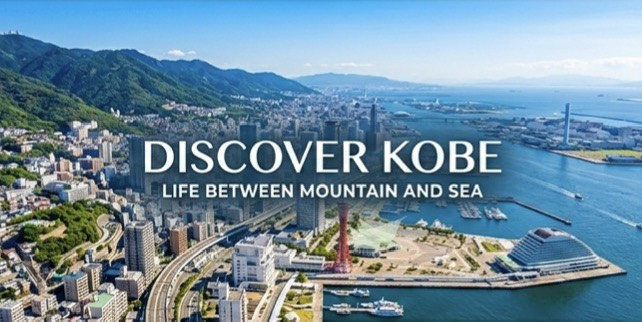
For over a century, Kobe’s Shinko Pier district served as the silent, industrial engine of Japan’s modernisation. As a primary gateway for international trade, these docks were functional, rugged, and largely inaccessible to the general public. However, the current “Kobe Waterfront Next” masterplan marks a fundamental pivot in the city’s spatial logic. The focus has shifted from the movement of cargo to the movement of people, transforming the Shinko Pier West District into a concentrated hub of art, technology, and high-end leisure. This is not merely a beautification project; it is a strategic repositioning of the port as a primary driver of the city’s aesthetic and economic appeal.
For far too long, there has been a strange, psychological wall between the bustling centre of Sannomiya and the water’s edge. Despite being a “port city,” the actual experience of the sea felt distant, blocked by bypasses and industrial grey zones. To me, the current transformation feels like Kobe is finally turning around to face the mirror. By dismantling the barriers that once separated the citizens from the waves, the city is reclaiming its soul. It is heartening to see these old, weathered piers being reimagined not as relics of the past, but as the foundation for a future where culture and commerce coexist in a way that feels uniquely “Kobe”—sophisticated, open, and resilient.
GLION ARENA KOBE: The Heartbeat of the New Port
The undisputed centrepiece of this coastal transformation is the GLION ARENA KOBE, a state-of-the-art, multi-purpose venue situated on the Shinko Pier No. 2. Slated for completion in 2025, this 10,000-seat arena is a very much example of a private-sector-led urban development. Beyond hosting the local B.League basketball team, the Kobe Storks, the arena is designed to be a 365-day destination. Its “Park-like” design integrates the building seamlessly with the surrounding waterfront plazas, allowing the energy of indoor events to spill out onto the docks, creating a vibrant, around-the-clock atmosphere.
From a strategic perspective, this arena is the missing piece of Kobe’s “Night-time Economy” puzzle. For years, the city struggled to keep visitors engaged after the department stores in Sannomiya closed their doors. An arena of this scale provides a legitimate reason for people to stay, spend, and celebrate well into the evening. I have always argued that Kobe needs a “magnet” that pulls both domestic and international crowds, and this project does exactly that. It transitions Kobe from a city you visit for a few hours into a city where you stay for the main event. Seeing the construction progress, one can almost feel the shift in the city’s gravity toward the harbour.
The Fusion of Art and Industry: átoa and the Stage One Complex
Adjacent to the arena, the “Stage One” complex has already begun to redefine the waterfront’s cultural density. The standout facility, átoa, is a “theatrical aquarium” that merges marine life with digital art and traditional Japanese aesthetics. This is complemented by the presence of Felissimo’s creative headquarters and the Stage Felissimo Chocolate Museum. By clustering these creative industries and artistic venues together, Kobe is moving away from the “one-size-fits-all” amusement park model and toward a more curated, intellectual form of tourism.
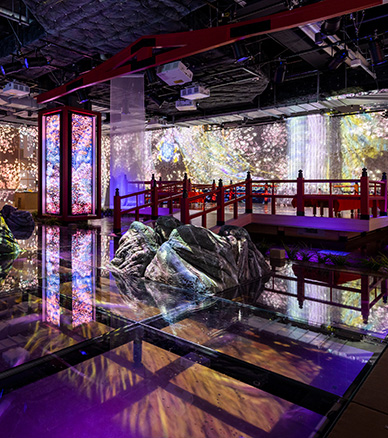
What fascinates me here is the deliberate avoidance of “clutter.” In many global waterfront developments, there is a temptation to fill every square inch with generic retail. Kobe, however, has opted for a more disciplined approach, focusing on “experience-based” assets. The integration of átoa’s surreal digital environments with the historic backdrop of the port creates a tension that is incredibly stylish. It is a reminder that Kobe’s strength lies in its “flair”—the ability to take something functional, like a pier, and infuse it with a sense of wonder. This is the kind of “dignity” I felt was missing from our earlier post-war developments, and seeing it realised here is deeply satisfying.
Bridging the Gap: The Logistics of Movement
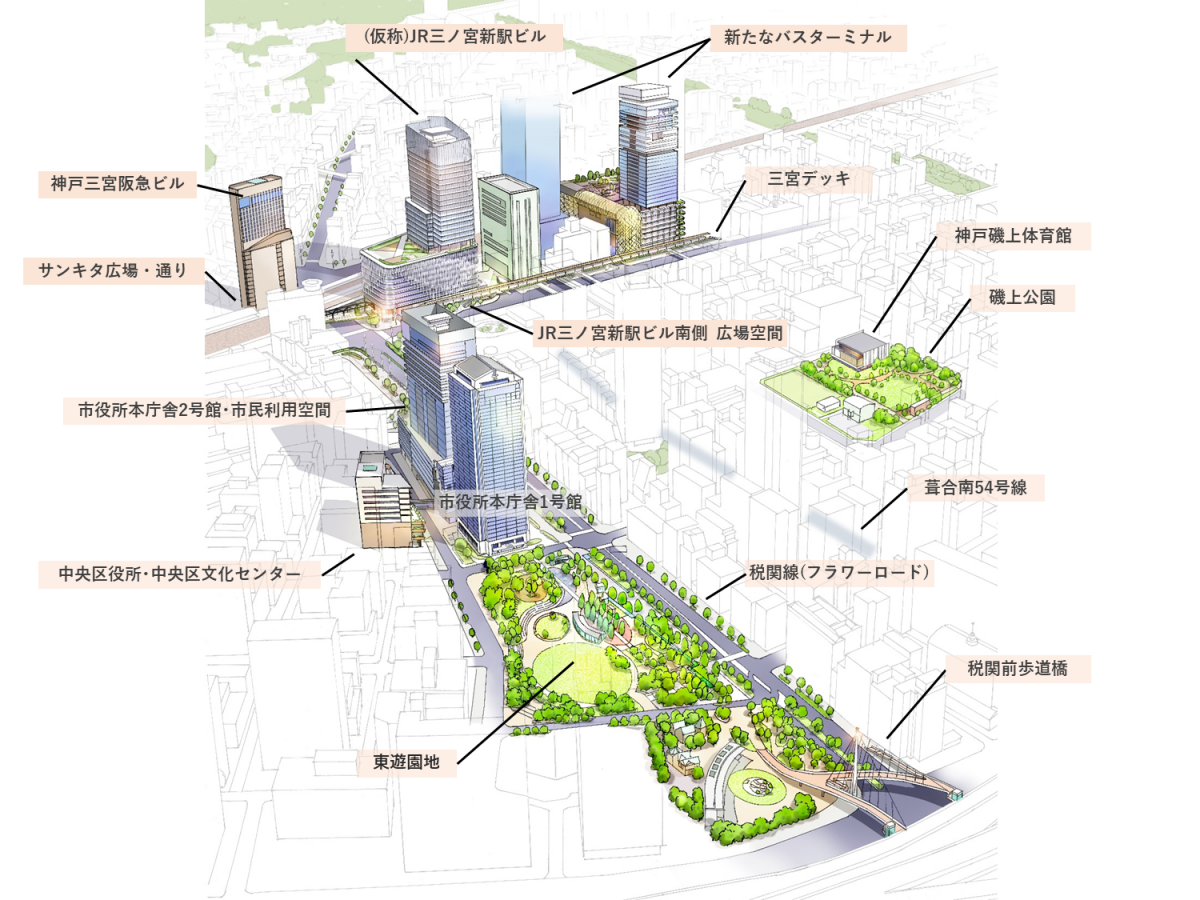
Connectivity is the lifeblood of any successful waterfront, and Kobe is addressing this through a sophisticated multimodal transport strategy. The “Port Loop”—a fleet of sleek, articulated buses—currently serves as the primary link between Sannomiya Station and the harbour. However, the long-term vision is even more ambitious, with discussions around LRT (Light Rail Transit) and enhanced pedestrian corridors designed to make the journey from the station to the sea as enjoyable as the destination itself. The goal is to create a “walking city” where the transition from the “Eki-Machi” space to the waterfront is fluid and intuitive.
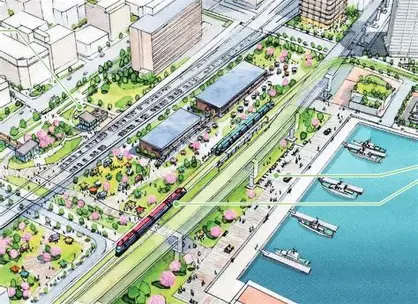
The success of the waterfront depends entirely on our ability to solve the “Last Mile” problem. While the Port Loop is a stylish interim solution, the ultimate goal must be to make the walk from Sannomiya feel like a scenic tour rather than a trek. I am a firm believer that the future of urbanism is pedestrian-centric. When the “Cross Square” in Sannomiya and the waterfront plazas are finally linked by a consistent, high-quality pedestrian experience, Kobe will truly become a world-class walkable city. We are not just building roads; we are building a narrative of movement that invites exploration.
Strategic Synergy: Why This Matters for the Centre
It is vital to view the waterfront redevelopment not as a competitor to Sannomiya, but as its essential partner. While Sannomiya is being reinforced as a high-intensity business and commercial hub, the waterfront provides the “breathing room”—the leisure, art, and relaxation that a modern workforce demands. This synergy is particularly important given the “Tower Mansion Ban” in the city centre. By concentrating residential quality in the suburbs and leisure on the waterfront, the city ensures that each district has a clear, uncompromised purpose.
This is the “Grand Design” in action. Critics who call this “hakomono” (wasteful construction) fail to see the socio-economic machinery at work. In an era where cities must compete for global talent and investment, having a world-class waterfront is a requirement, not a luxury. By refusing to clutter the harbour with residential towers, Kobe is preserving its most valuable asset for public and commercial use. This is a courageous policy. It prioritises long-term urban vitality over the short-term gains of residential developers. In my view, this is exactly the kind of “tough, fair-minded” governance that will ensure Kobe remains a leader in the decades to come.
Conclusion: The Horizon of Possibility
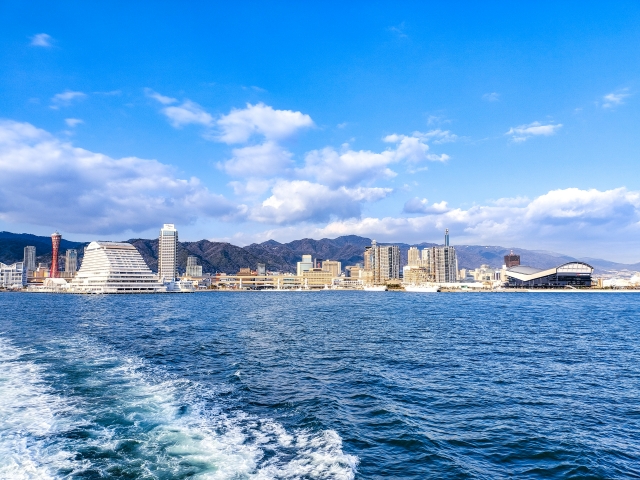
As we look toward 2026 and the opening of the arena, the silhouette of Kobe’s coastline is changing irrevocably. The industrial cranes are being replaced by architectural landmarks, and the sound of cargo ships is being joined by the cheers of arena crowds. While the construction work along the waterfront remains a temporary obstacle to navigation, the result will be a city that is finally whole.
The evolution of the waterfront is the ultimate proof that Kobe has moved beyond the shadow of 1995. We are no longer just “recovering”; we are reimagining what a port city can be in the 21st century. The growing pains we experience today—the detours, the noise, and the dust—are the necessary precursors to a magnificent opening act. For those of us who have watched this city for years, the sight of the sea finally being returned to the people is the greatest reward of all.
Reference, Kobe water front ground design, 20250421145711.pdf